Textbook definition: Upstream processing refers to the stage of bioprocessing where cells are grown to the desired quantity in bioreactors, and all stages related to this such as cell isolation, cell cultivation, media preparation, cell banking & storage to culture expansion until harvest.
Basically, upstream processing is everything related to mass-production of the cells and product.
A simple diagram of the upstream process stage of a bioprocess.
Innoculation: Introduction of the cells to media to initiate cell expansion.
Cell expansion: Increasing the amount of cells by scaling up the process.
Upstream processing is important as in order to make a scientific breakthrough into a product on the market it must be able to made in large quantities at a low cost.
As cells are living organisms, designing an upstream process is complex and many factors must be taken into account, i.e. oxygen dispersion, shear sensitivity of the cells, nutrient concentrations, etc. We will go through all of these factors in later posts. Due to the cells complex nature it is usually necessary to start the process at a small-scale and then increase the size of the vessel in increments.
Ensuring the cells produce the desired amount of product is also a part of upstream processing, but we will put the genetic engineering sections in our “Everything you need to know about cells” category as it seems more relevant to cells, and instead focus on optimising upstream conditions to maximise product synthesis.
Textbook definition: The process by which cells are grown under controlled conditions.
A cell culture is when cells that have been isolated from their original host are grown under artificial conditions. Cell culturing is one of the most important parts of bioprocessing, as without it there would be no bioprocessing!
We want to culture cells because cells are capable of performing complex reactions that might not be possible, or are economically unrealistic with chemical synthesis. Additionally, cells themselves can be commercially or medically desirable, such as stem cells. Here are some examples of what cell culturing can be used to make:
Stem cells (for regeneration or replacement of organs or tissue)
Biofuels
Alcohol
Model systems for research
Model systems for research are cell cultures are used to test the effect of new drugs on living organisms. For example, testing the effectiveness of an antibiotic on a bacterial cell culture. Commonly used cell types for research model systems include e. coli cells, zebrafish cells, mice cells, pig cells and chimpanzee cells.
The advantages of using cell cultures are model systems for research are:
Cells of interest can be observed without the interference of unwanted cells or tissue
The effect on the cells can be monitored and observed in real-time because it is in vitro (outside the body)
Cheaper and faster than the majority of animal experiments
Has far less ethical concerns than animal experiments
In some cases can provide more representative data than using animal models
Types of cell cultures
Primary Cell culture
A primary cell culture is when the starting material has been extracted from tissue or organs of the host organism (i.e. via a biopsy). The culture has only been through a few population doublings and cannot be used indefinitely. Proteolytic enzymes are often used to digest the tissue into it’s single cell forms.
Pros
Representative of the original tissue in vivo (in the body) since it was recently extracted and hasn’t been mutated/ modified.
Cons
Slow growth
Short life-span – not many population doublings
Not well characterised – since the culture always comes from host tissue it is not well-understood, which makes it harder to grow efficiently
Secondary Culture
A secondary culture is formed after the primary cell culture undergoes its first subculture (the transfer of the cell culture to a new mediaL).
Established Cell line
If further subcultures are possible, an established or immortalised cell line is formed. As most cells stop dividing after a certain number of population doublings, to proliferate indefinitely one cell in the culture must undergo one of these changes:
Random Mutation
Artificial modification (genetic engineering i.e extending the telomerase at the end of the cell’s DNA or insertion of a cancer causing gene, exposure to a cancer causing antigen i.e. radiation)
The oldest and most characterised human cell line is the HeLa Cell line, named after a woman called Henrietta Lacks. Henrietta died of cervical cancer in 1960, but before her death doctors extracted her cancer cells (without her knowledge). Cancer cells are able to undergo indefinite division and rapid proliferate due to a random mutation, and her cells formed the first immortalised human cell line. This has helped achieve significant breakthroughs such as the creation of the polio vaccine. However, her family still has received none of the benefits and still cannot afford health insurance. Henrietta was a black woman, and for that reason doctors believed they did not need her consent or to give any recognition to her family, causing a lot of outrage and further implicates the need for ethics in the scientific field. The book, The Immortal Life of Henrietta Lacks, provides a great insight into the formation of bioethics and about the HeLa cell line, and I would recommend it if you have an interest in this field:
The Immortal Life of Henrietta Lacks by Rebecca Skloot. Click the picture to go to the amazon page!
Choice of cell:
The choice of what cell type to use depends on various factors:
Source of organism: the ease of obtaining organism, the type of organism needed. For example, although embryonic stem cells are highly valued for their indefinite growth and regenerative capabilities, but as the organism is a human embryo it is a controversial source to use.
Source of tissue: Ease of obtaining tissue, the type of cells needed – i.e. if testing effect of a medication on heart tissue you would not use neuronal cells.
Primary culture or cell line: A cell line is usually preferred since they are more characterised, making it easier to grow them effectively and rapidly. However, for some cell types (i.e neuronal cells) only a primary culture is possible.
Some examples of common cell lines are E. coli, yeast, Chinese hamster ovary (CHO) cells
Typical Growth Curve
We will go through growth curves in more detail in its own post, but I will outline what a growth curve should look like here. A growth curve represents the speed of proliferation of the cells, and tends to vary over the duration of a cell culture. There are 6 stages of cell growth:
Lag Phase: Cells have just been introduced to the media and are adapting to the new environment. Proliferation is close to 0.
Acceleration Phase: Cells begin to divide and growth rate starts to increase.
Growth Phase. The maximum growth rate possible is achieved.
Deceleration Phase: Growth rate decreases over time due to a rate-limiting step (lack of nutrients, too little space)
Stationary Phase: Proliferation decreases to 0 due to rate limiting step.
Death Phase: Cells begin to die due to rate limiting step. Growth rate turns negative.
Graph depicting a typical growth curve.
The rate limiting step generally occurs when the nutrients, growth factors etc. in the media have been used up. To combat this subculturing is done. Subculturing is when the cell culture is moved to a fresh media, removing the rate limiting step and allowing the cells to re-enter the growth phase. This will be explained in more detail in the upstream processing section.
Cell Quantification
Quantifying the cell culture is necessary to understand the growth of the cells and to ensure the cells are alive and proliferating. Cell culture quantification is usually done by cell counting. A viable cell count is more common as it tells us how many cells are alive, the proportion of alive to dead cells, etc. Cell counts are mainly automated these days, using a machine that stains the cells with a reagent such as tryphan blue, which only stains damaged cells, distinguishing the ratio of dead to alive cells.
This is just the basics of cell culture: we will go into cell culturing in more detail later on. If you have any questions or if I didn’t explain it thoroughly enough, please let me know down in the comments and I will give you more information and try to explain it with more detail. This is my first blog so I will appreciate any constructive criticism!
These are the fundamental equations you need to know, not ALL the equations. Nowhere close (good luck). But as these equations commonly show up, I would recommend reading through them and understanding them
Dimensionless variables
In my previous post we talked about physical variables, but only went through one type: substantial variables. Here we’ll talk about the 2nd type: natural variables (also known as dimensionless variables). Natural variables are variables that are dimensionless, hence have no units. They can occur when the substantial variables used to derive the natural variable cancel each other out, or do not require any units to express magnitude (i.e ratios).
In bioprocessing, dimensionless variables are often used to represent a physical phenomenon that is the result of multiple substantial variables. Since bioprocessing involves many complex processes (reactor configuration, operating conditions, liquid properties), it is usually simpler to represent them as a dimensionless group that is the sum of all these processes. This is called dimensional analysis. We will go through this later on, but right now you just need to know of their existence.
Reynolds Number (Re)
You probably already know of this; if not, you will do very soon! It is likely the most common dimensionless group in the field! Reynolds number is simply the ratio of inertial forces (creating motion) to viscous (reducing motion) forces, and is used to describe the turbulence or “chaos” in the fluid.
Re = inertial forces / viscous forces
In terms of physical variables, this is the equation for Reynolds number in pipes:
Re = ρud/μ
Where:
ρ = Liquid density (kg/m³)
u = Liquid velocity (m/s)
d = Diameter of Pipe (m)
μ = Liquid viscosity (Pa.s)
And this is the equation for the Reynolds number in tanks:
Re =ρNdi²/μ
Where:
ρ = Liquid density (kg/m³)
N = Rotational speed of impeller (in rotations per second, RPS or s-¹)
di = Diameter of impeller (m)
μ = Liquid viscosity (Pa.s)
If we are to write down all the SI base units:
[kg/m³] x [m/s] x [m] / m-¹ x kg x s-¹
[kg/m³] x [m/s] x [m] / m-¹ x kg x s-¹
= kg x s-¹ / kg x s-¹ = kg x s-¹ / kg x s-¹ = 0
Proving that the Reynolds number is a dimensionless variable
The Reynolds number is an important dimensionless group as it tells us the turbulence of the fluid, which is linked to how well mixed the fluid is. The Reynolds number tells you the type of flow of the liquid:
Laminar flow: Occurs when Re<10-⁴. In this type of flow, liquid moves in regular patterns and will not mix.
Transitional flow: Occurs when Re is between 2100 and 10000.
Turbulent flow: Occurs when Re>10⁴. In this type of flow, the fluid is moving fast and in a chaotic manner. Linked to well mixed.
Generally, we want our fluid to possess turbulent flow as it is linked with good mixing (but not always!)
Power number (Po)
This is another common dimensionless variable that you will come across. Power number is different for each impeller design and is related to power consumption of an impeller. We will go through this during Fluid mechanics and Reactor design.
Po = Pug / ρ x N³ x di⁵
Where:
Pug = Ungassed power consumption
ρ = Liquid density (kg/m³)
N = Rotational speed of impeller (in rotations per second, RPS or s-¹)
di = Impeller diameter (m)
Basic equations you should know
You will have learnt this in high school if you did chemistry, but if you didn’t (like me), here are some of the basic equations you must know.
Molar Mass/Molecular Weight (g/mol)
The molar mass is the mass, in grams of 1 mole of a molecule. It’s basically means the same thing as moles. To find the molar mass of a molecule, you just add up the individual molar masses of each element in the molecule.
For example:
C₆H₁₂O₆ or Glucose
C, Carbon, has a molar mass of 12g/mol
H, Hydrogen, has a molar mass of 1g/mol
O, Oxygen, has a molar mass of 16g/mol
So to find the total molar mass:
(12 x 6) + (1 x 12) + (16 x 6) = 180g/mol
Also, remember that a mole is equal to 6.02 x 10²³ of that molecule. I have only used this equation in my chemistry modules but I feel like it’s the basic foundation of chemistry/biochem and you should probably know that if you pursue a career in the field.
Mass (g) = molecular weight (g/mol) x moles (gmol)
You’ll probably know this but just in case you don’t, remember this! It pops up a lot and is one of the fundamental equations. I use the equation triangle to remember it, which I’ve put below:
If you need to work out one of the variables, cover it with your thumb, and the position of the two remaining variables lets you know how to calculate it i.e. if you want mass, you need to multiply molar mass by moles, but if you want moles you must divide mass by molar mass.
Molar mass is the number of neutrons and protons in an element. It’s given in the periodic table (it’s also called molecular weight), but you should know the 4 important ones:
Carbon: 12
Hydrogen: 1
Oxygen: 16
Nitrogen: 14
Concentrations
There are 4 main equations for calculating concentration:
Amount per volume: N/L³ (units mol/L or M) – Concentration (mol/L) = amount /volume or moles/ volume – Used for salts, buffer concentrations, etc.
Mass per volume: M/L³ (units g/L) – Concentration (g/L) = mass /volume – Used for molecules dissolved in water i.e DNA/ RNA concentrations, protein concentrations, etc.
Weight per volume (Written as a percentage): M/L³ (Units: %) – Concentration (%) = mass /volume x 100 – Same equation as 2. but is written as a percentage i.e. 30% glucose dissolved in water
Volume per volume (Percentage): L³/L³ (Units: %) – Concentration (%) = volume 1/volume 2 x 100 – Used for liquids dissolved in other liquids (e.g. detergents,)
Stock Solutions
Stock solutions are used to dilute a fluid so that you can manipulate the concentration until it is what you need. This is commonly used to make buffers.
Concentration of stock x volume of stock = concentration of final solution x volume of final solution
Cstock x Vstock = Cfinal x Vfinal
If you know 3 of the variables, you can use this equation to find the remaining value. For example if you want to know how much volume of stock you need to get a solution of desired concentration and volume, you can find it by dividing the right side of the equation by Cstock:
Vstock = (Cfinal x Vfinal) / Cstock
Dilution factors of stock solution
if you want to dilute a solution by a certain factor, you can use this equation:
Vstock = Vfinal/Dstock
It’s similar to the last equation, right? Dfinal is always 1, therefore it is cancelled out. To remember how to calculate each variable, you can use the triangle method that I did for molar masses.
Based on the equations, here are some questions you can try out:
I have 2 moles of glucose. How much do I have in grams?
What is the molar mass of C₂OH₄?
I have 2 litres of buffer containing 0.4 mol/L of C₂OH₄. How much do I have in grams? (this question uses 2 equations)
I have 4 nanograms of DNA in a 1 millilitre solution. What is the concentration?
If I want a 40% glucose solution, and I have 1 litre of water, how many grams of glucose do I need to add?
I have a stock solution of 5 litres containing 2g/L of glucose. If my final volume is 3L, what is the final concentration?
If I haven’t explained this in enough detail, please leave a comment and I will write another post to answer your question and go through the topic more.
These are the common physical variables and units used in bioprocessing. I know these are quite simple, but since I started this course with barely enough chemistry, physics or maths to pass GCSEs, so I thought it would be useful to write about for any other noobs like me.
*Since I study in the UK my main focus will be on the metric system, but I’ve written some information about converting between them.
Bioprocessing involves a lot of engineering calculations, which in turn involve a lot of manipulation of physical variables. A physical variable can be defined as a physical property of something that can be quantified by measurement (i.e. weight, height, length, etc).
There are 2 types of physical variables:
Substantial variables
Natural variables
Lets focus on substantial variables for now. Substantial variables can be attached to units to quantify a measurement. Examples of substantial variables include mass, volume, length, pressure, temperature, time, etc. To express the magnitude of these variables, you need to use precise physical measurements, also known as… Units!
The value of a measurement is split into 2 parts: the number and the unit used for measurement (obviously).
Basic rules:
You can only add/ subtract substantial variables if they have the same unit. I know this is simple but REMEMBER THIS IN EXAMS. They WILL try to trick you with the units. Always convert all the physical variables into the same units (i.e cm to m, g to kg) before doing the calculation, and ALWAYS DOUBLE CHECK YOUR UNITS ARE CORRECT.
You can divide/ multiple units to get different physical variables: for example, density is the weight per unit volume, or kg/m³.
SI Units
SI Units are the agreed upon units of measurement used in the U.K., and common throughout the world. There are agreed upon 7 base quantities (substantial variables that cannot not be derived from other variables):
Luminosity and electric current aren’t really important, so you don’t have to worry about those. I’ve only put in the dimensionless symbols so that we can look at derivations of physical variables more easily, you don’t need to remember them.
Little fact: mols and gmol mean the same thing, they are both just moles. I was really confused by this during my first year exams so I thought I’d put it in.
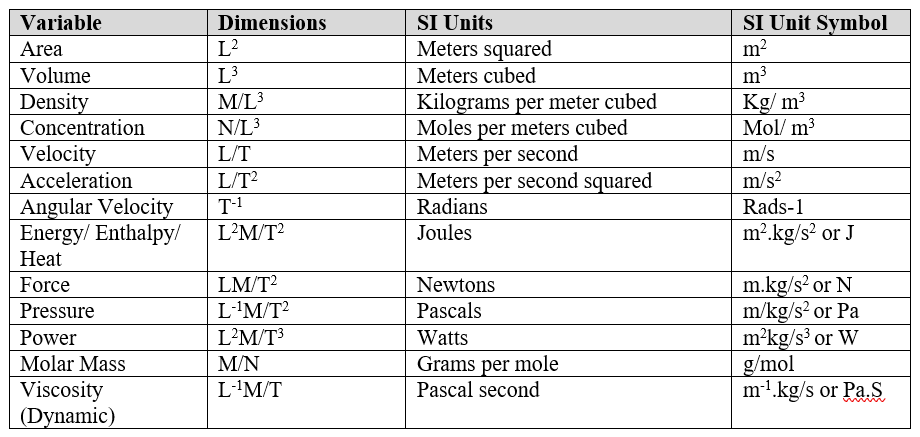
From these 7 base quantities, other physical variables can be derived i.e. speed = L/T or m/s, acceleration = L/T² or m/s². I’ve put a list of all the important derived physical variables you will need to know. I recommend reading and understanding these thoroughly, especially Newtons, Watts, Pascals and Joules as it will help you make sure your answers are correct. Also, if you forget an equation, knowing the units can help you guesstimate what the equation is!
Unit conversions
Most physical variables have multiple units to indicate what the magnitude of the substance is, i.e a kilogram is the same as 1000 grams. Additionally, there are two main systems of measurements: imperial (yards, pints, pounds) and metric (meters, litres, kilograms), and if you decide to move to a different country or are working with a team in another country you will need to be familiar with their unit system. I wouldn’t worry about this since you can just put them into google, though you might get a few questions on your test asking you to convert between systems (if your teacher is especially annoying).
Common Multiplicators
These are prefixes used in front of SI units to indicate the magnitude of the unit; when you see these prefixes use the multiplicator to convert them:
Kilo (k): 1000x bigger = x10³
Mega (M): 1,000,000x bigger = x10⁶
Giga (G): 1,000,000,000x bigger = x10⁹
Milli (m): 0.001x bigger = x10-³
Micro (μ): 0.000001x bigger = x10-⁶
Nano (n): 0.000000001x bigger = x10-⁹
But remember this: A kilometer is 1000x longer than a meter, so there are 0.001 kilometers in a meter. I used to always get this mixed up (yeah I was that behind lol)
Also, when dealing with derived dimensions i.e. density (kg/m³ ), you have to take into account the position of the units. For example, if we want to change m³ to litres (there is 1000 litres in 1 m³), you will have to DIVIDE the density by 1000 since we are looking at the amount of mass per unit volume: if we decrease the volume by 1000 then the mass in that volume will also decrease by 1000. However, if we convert m³ to L, then we will MULTIPLY the value by 1000 since there is 1000 litres per m³ and we are increasing the magnitude of the volume, hence we are counting 1000x more volume. Sorry if this is confusing, I’m finding it hard to explain this concept so please leave a comment if you are confused and I will explain it further or go through some exercises to help you understand.
Unity brackets
I still use unity brackets nowadays – they can be applied to any type of unit conversion and are much more efficient than doing them in your head. It’s quite hard to explain, but I’ll try my best.
Old value x [new SI unit/ conversion rate] = new value.
Basically, you multiply your variable by the conversion rate. The unity bracket should contain the original units and the conversion rate of that unit. For example, if I was converting from grams to kilograms, the unity bracket will have 1 gram and 0.001 kilograms, since 0.001 is the conversion rate of g to kg. The unity bracket should be arranged to allow you to cancel out the old SI unit. Here’s an example of me converting kilograms to grams using it:
2kg x [1000g/1kg] = 2kg x [1000g/1kg] = 2 x 1000 = 2000g.
The unit kg is on the bottom of the unity bracket fraction so that it will cancel out with 2kg. If that’s hard to understand, visualise a 1 underneath the 2kg to present it as a fraction:
2kg/1 x [1000g/1kg]
Here is the use of the unity brackets for converting density. Let’s say we want to convert kg into grams and m³ into litres (dm³):
2kg/m³ x [1000g/1kg] x [1m/ 1000dm]³
2kg/m³ x 1000g/1kg = 2kg/m³ x 1000g/1kg =
= 2 x 1000 = 2000g/m³
[2000g/m]³ x [1m/1000dm]³
= [2000g/m]³ x [1m/1000dm]³
= 2000/1000 = 2g/dm³.
I think this makes more sense? If not, please comment and I will upload more examples + a better definition if possible (I’ve lent my laptop to my friend so I don’t have my own resources right now, but I will by the time this blog gets any attention… if it gets any attention at all). Also, as you see in the example above, if a unit is raised to a power, you must move that power so that the conversion factor is also raised to the same power. This is easier to follow if you make a mistake and makes conversions more simple.
Some common conversion factors between unit systems
I’ve forgotten most of them because we rarely do this at uni, but here are some of the basic ones:
1 pound (lb) = 453.6 grams
1 kilogram = 2.2 pounds
1 inch = 2.54cm
1 ft = 30.48cm
1 ft = 0.3048m
So if we were to use the unity bracket to convert between kilograms and pounds:
4kg/1 x [1000g/1kg] x [1lb/453.6g]
4kg/1 x [1000g/1kg] = 4kg/1 x [1000g/1kg] = 4 x 1000 = 4000g
4000g x [1lb/453.6g] = 4000g x [1lb/453.6g]
= 4000 / 453.6 = 8.81 lbs
I hope this helps – I’m not the best at describing things (but this blog should help!) so if you have don’t understand it leave a comment and I will try to delve into this topic more and give you more examples.
In your exams/quizzes you might come across questions that ask you to define certain terms, so I’ve included a list of textbook definitions for each term that you might need to define.
Biotechnology-related terms
Bioprocessing: The cultivation and use of living cells to for biological material or processes for medical or commercial purposes. A branch of biotechnology, often used for development of manufacturing processes.
Biotechnology: Commercial techniques that use living organisms, or substances derived from living organisms, to make/ modify a product. This does not include agricultural/ranching unless genetic engineering has been used.
–Industrial biotechnology: The use of living cells/and or their enzymes to produce or process commercial and industrial products. Usually it is cheaper than using traditional methods (i.e. extraction or catalysis).
Bioengineering/ Biomedical Engineering: The application of engineering principles to biological or biomedical products.
Medical Biotechnology: Medicine derived from the use of genetics, cell biology and other sciences.
Bio-pharmaceuticals: Biologically significant compounds that are used to treat human disorders. This is different from pharmaceuticals because they are not chemically synthesised i.e insulin. Does not include compounds directly extracted from tissue.
Regenerative Medicine: Any therapy that induces regeneration of an organ or tissue in the case of disease, injury or developmental defects.
Tissue Engineering: The use of engineering and biological principles to create a viable substitute for an organ, with the aim of restoring, maintaining or improving the function or an organ or tissue.
Biochemical Engineering: The use of bio-catalysts to produce a desired chemical transformation. Extends off chemical engineering.
Bioprocessing-specific terms
Upstream Processing: The mass manufacture of a desired product using cell cultivation processes.
Downstream Processing: The isolation, purification and formulation of a product from cell broth to form the final product format.
Formulation: Techniques used to generate the final product form from the bulk product. The final product form is ready to be used commercially/ medicinally, or to be stored and transported.
Quality control: Ensuring the product quality, safety, and efficacy are maintained within a certain range that meet the Good Manufacturing Practice standards set by the FDA.
Unit operations: Individual steps in a process that change or separate components of the cell broth. For example: centrifugation, filtration.
I will go over the bioprocessing terms in more detail, in their own sections as they are topics of their own, but I hope this is useful for you guys when you are cramming/ need a reminder!
So, we know that bioprocessing means producing something by using living cells.
Bioprocessing can be used to make hundreds of products from antibiotics and vaccines, to cell & gene therapies, to biofuels, to commercial products like sweeteners (Aspartame) or meat substitutes (Quorn).
But how does a bioprocess actually work?
Typical chemical processing
Normally, when you are making a product chemically, you have a process that looks like this:
Of course, this is very simplified. But the point is that you put some stuff together, you put it in a reactor, chemical reactions occur and you get new stuff (your product).
How bioprocessing is different
In bioprocessing, your product is formed by living cells. In other words, the cells are your mini-reactors. Your job as an engineer or a scientist is to make sure that the cells have the optimal conditions to produce the desired product. For example, cells would need enough oxygen and a nice temperature – not too cold but not too hot.
Hence a cell could be pictured like a bioreactor:
So, you give A and B to the cell, these could be glucose and oxygen for example, and it produces P – your product. Cool, right?
In reality, you have to take care of a lot more things than A and B, and your cell will produce a lot more that just P.
A more realistic schematic:
Two things to notice here:
There are a lot of factors to take care of to make sure the cells have a good environment to make product in.
There are a lot of things a cell produces apart from the product – these need to be removed from the final formulation.
These two considerations give rise to the two main parts of a bioprocess: upstream and downstream.
Upstream and Downstream
Upstream processing refers to the part of the process from picking the correct cell type, to cultivating it, to growing it and making it produce the things you want it to produce.
Downstream processing is concerned with everything that follows after your product is formed. This includes all the isolation and purification steps that are needed to separate the product from everything in the mixture, as well as the formulation of the product from a container of cloudy liquid into a sealed package that can be distributed.
Upstream are downstream are described in more depth in the “Upstream processing” and “Downstream processing” categories.
I don’t think I know enough about the details of the full history of bioprocessing to do a post on it, but if you wanted to learn more about bioprocessing in general I highly recommend watching the 2nd episode of Pain, Pus and Poison: A search for Modern medicines by Michael Mosley. The documentary highlights what life was like before bioprocessing of medicine was like, how bioprocessing came about and how useful it has been. In first year this documentary sparked my interest and my motivation to work in the field – it’s interesting yet informative, and not hard to follow. You can buy the episode to watch on Amazon and a few other websites such as enhancetv.com.au, or if you’re doing a degree in this subject you could watch it for free on http://www.learningonscreen.ac.uk.
Textbook definition: Bioprocessing is the cultivation and use of living cells to create biological material or processes for medical or commercial purposes.
In the simplest of terms, bioprocessing is a method of mass manufacturing cell-derived products. Bioprocessing is important because it bridges the gap between research and public access, in a consistent and cost effective manner.
A bioprocess usually follows this order: 1. A cell type is selected or genetically modified to produce a certain protein or molecule. (For example, yeast cells) 2. These cells are then put into tanks (bioreactors), which is filled with fluid containing nutrients, glucose and other components the cell requires to live and reproduce (media). 3. The cells are then usually transferred to progressively larger bioreactors to increase the amount of cells in the media, or now called a cell broth. This is called Upstream processing. 4. The product is then isolated from the cell broth via purification methods i.e. filtration (shown below). There tend to be multiple steps of purification, called Downstream processing. (Cells can also be the product – for example red blood cells) 5. The product is completely purified from all other components of the cell broth and can be modified to be stored or transported. This is called Formulation. This usually involves freeze-drying the product so that it is stable for a long period of time.
(Excuse my crappy simplistic sketch, trying not to get sued)
I’ll go into each step in detail in future posts, but I hope you guys can get the general idea of what bioprocessing is.
Bioprocessing is used to create many products – hormones (i.e Insulin), antibodies, vaccines, cheese, wine, detergents… the most common example is probably beer. Beer is made by growing yeast in a container with sugar but no oxygen, causing it to create a byproduct of anaerobic respiration, called ethanol, or also known as… alcohol! With such large advances in the field of biotechnology in the past few decades, what was thought of as science fiction will become possible. Lab grown organs, limbs and meat could become accessible to everyone in the near future. For whoever reading this, you have definitely picked the right field to be in!


 The Immortal Life of Henrietta Lacks by Rebecca Skloot. Click the picture to go to the amazon page!




 Bioprocessing Explained